
OpenEverest for Neo4j
Run the Neo4j graph database on any Kubernetes cluster. Start a Community server or an Enterprise cluster from a preset, add analytics and read servers, back it up to S3-compatible storage, restore it, and chart its metrics, all through one UI and API, powered by the Neo4j Kubernetes Operator.
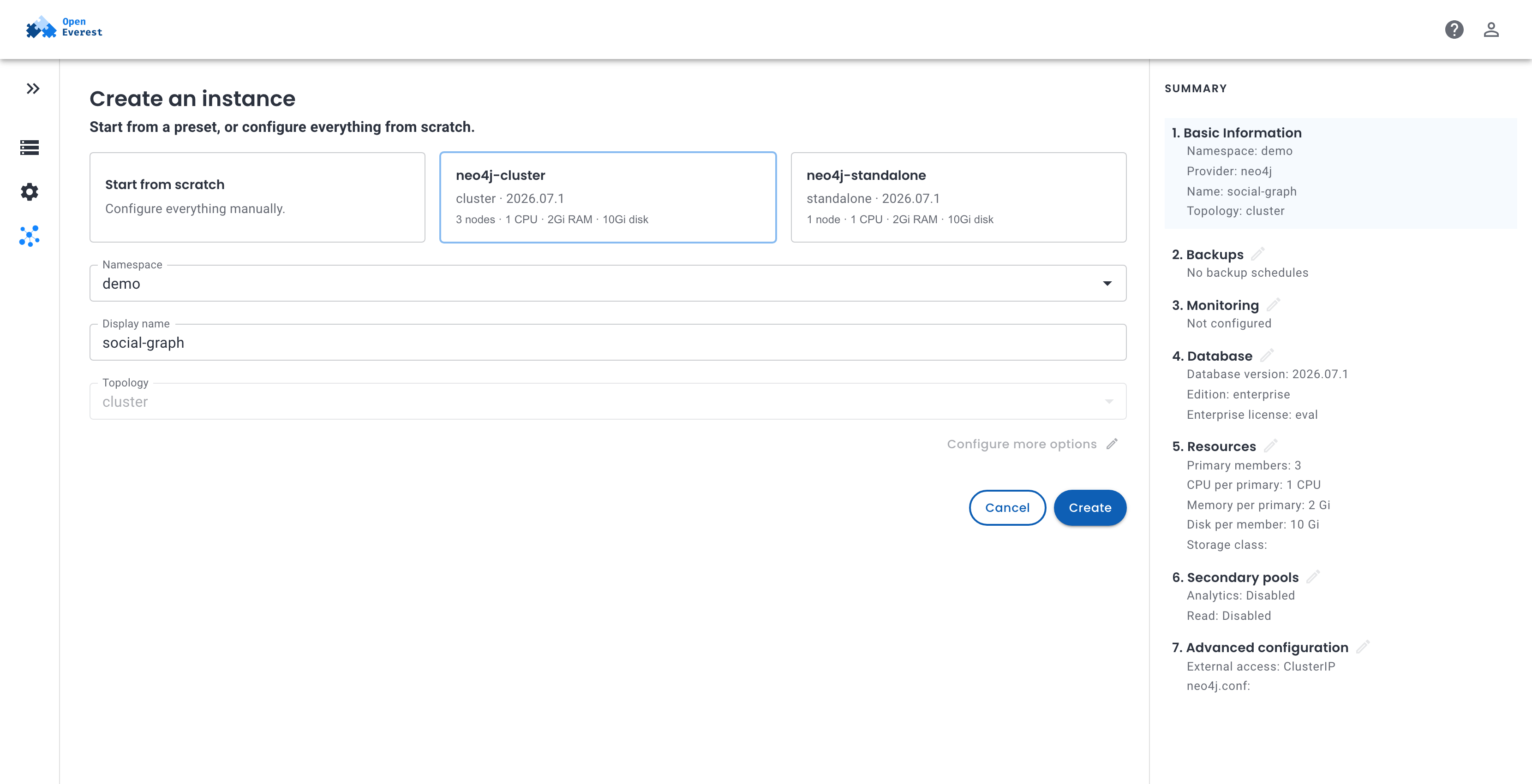
Start From a Preset
Pick the Community standalone preset or the three-member Enterprise cluster preset, choose a namespace and a name, and create. The summary shows every setting before you do.
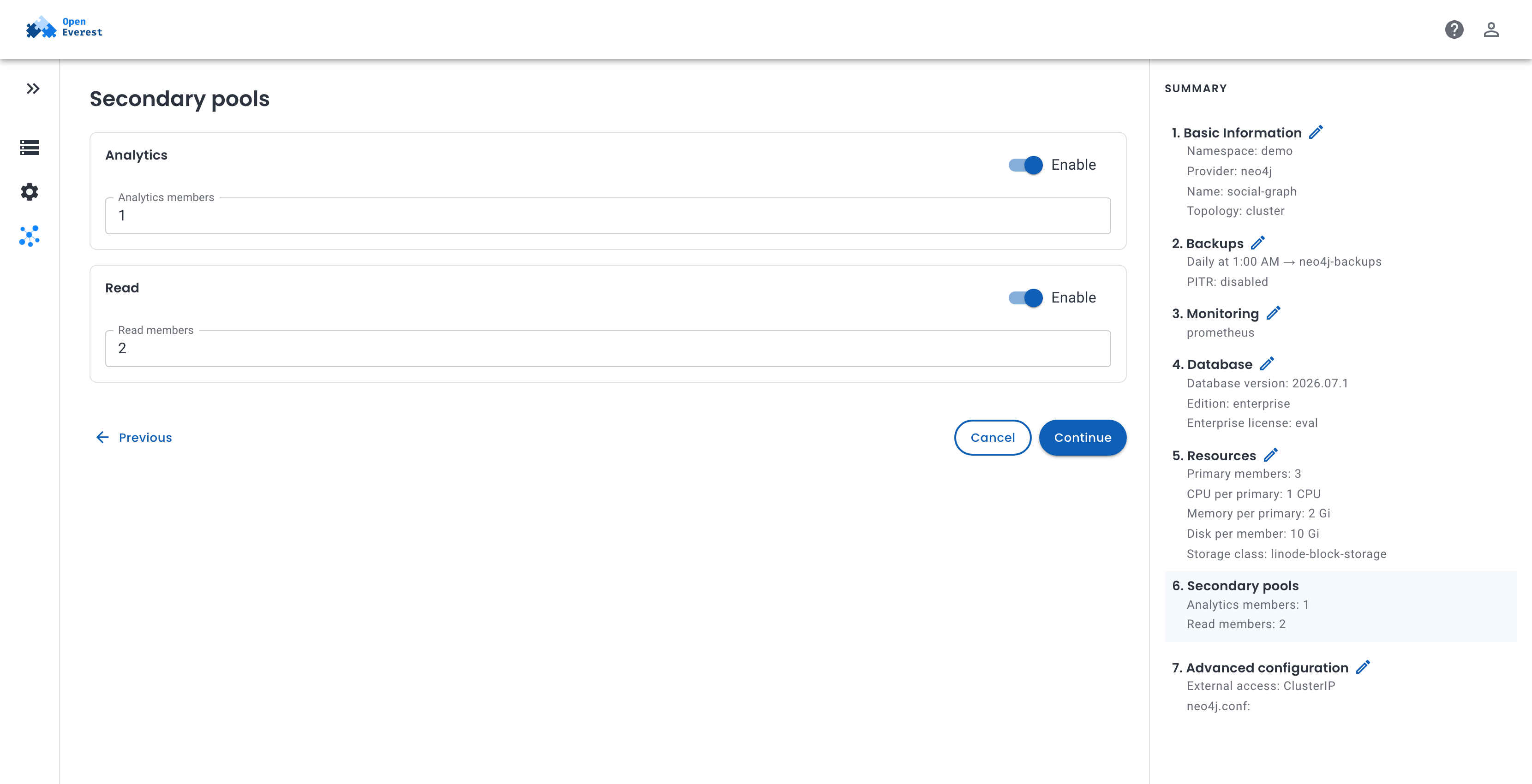
Primaries, Analytics and Read Servers
Run three or more primaries and add an analytics pool for heavy graph queries and a read pool for read traffic, each sized on its own.
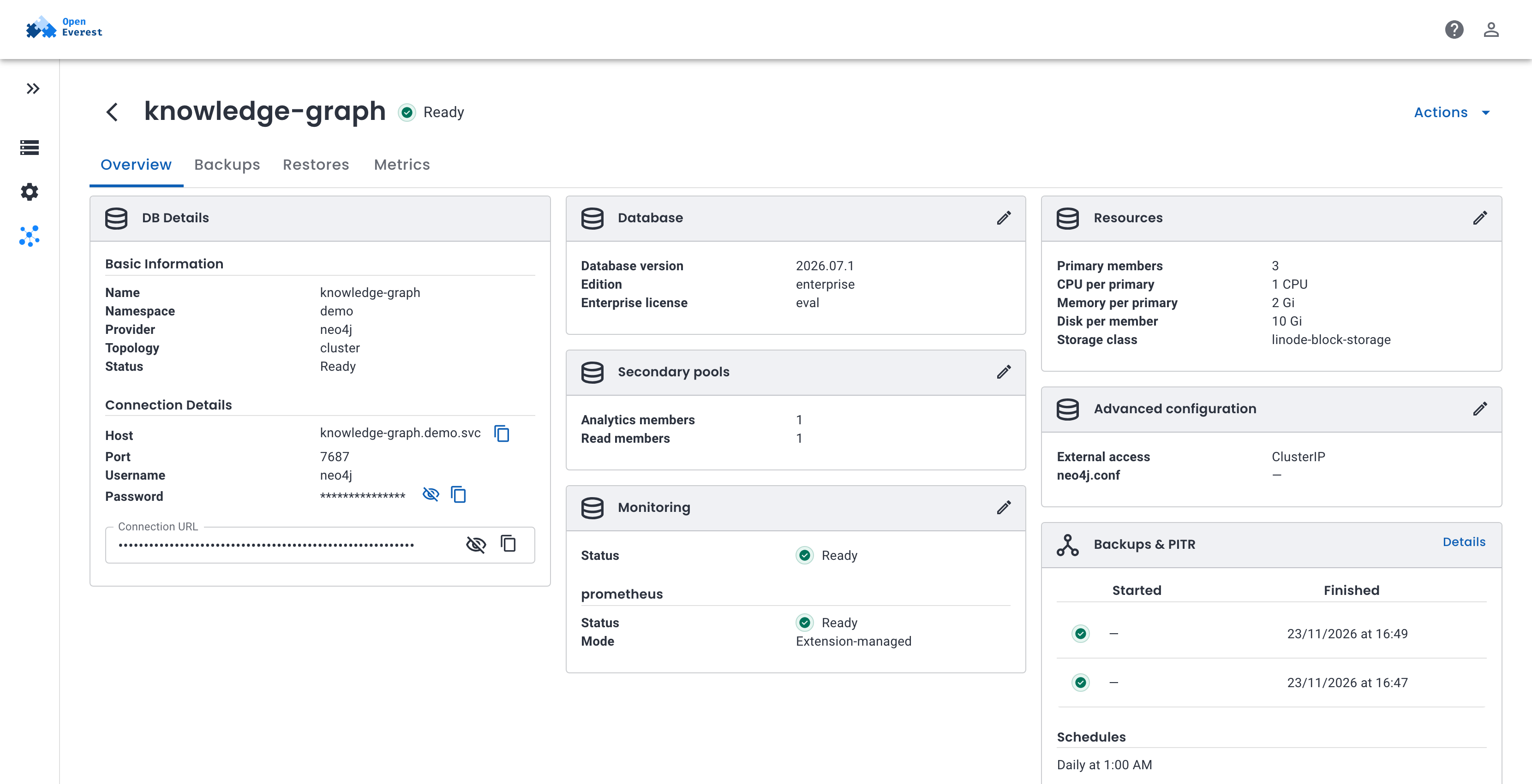
Cluster Overview
Copy the Bolt endpoint, credentials, and TLS connection URL, and review the edition, license, members, pools, monitoring, and backups at a glance.
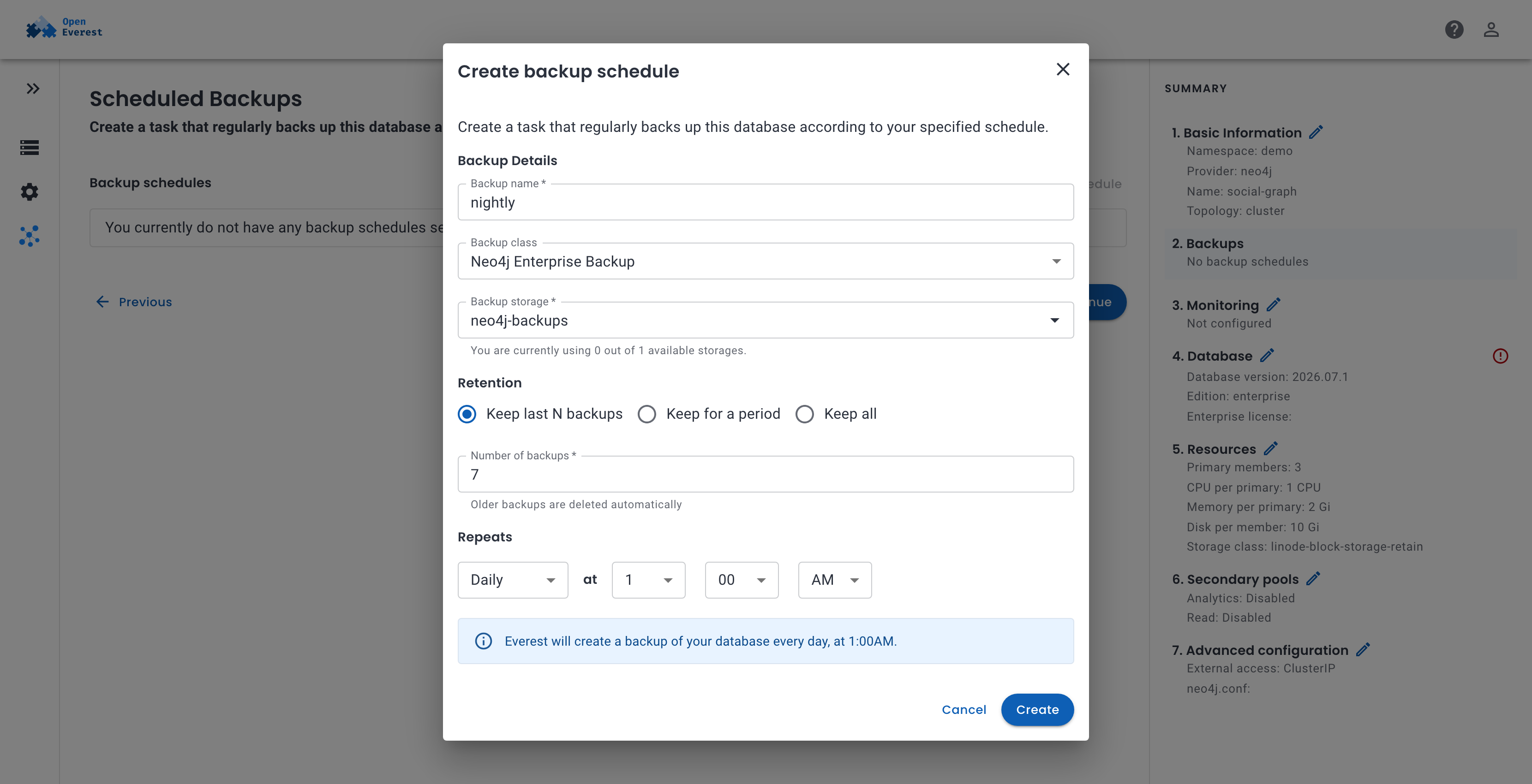
Scheduled Backups
Schedule Neo4j Enterprise online backups to any S3-compatible storage with count- or time-based retention, or take one on demand.
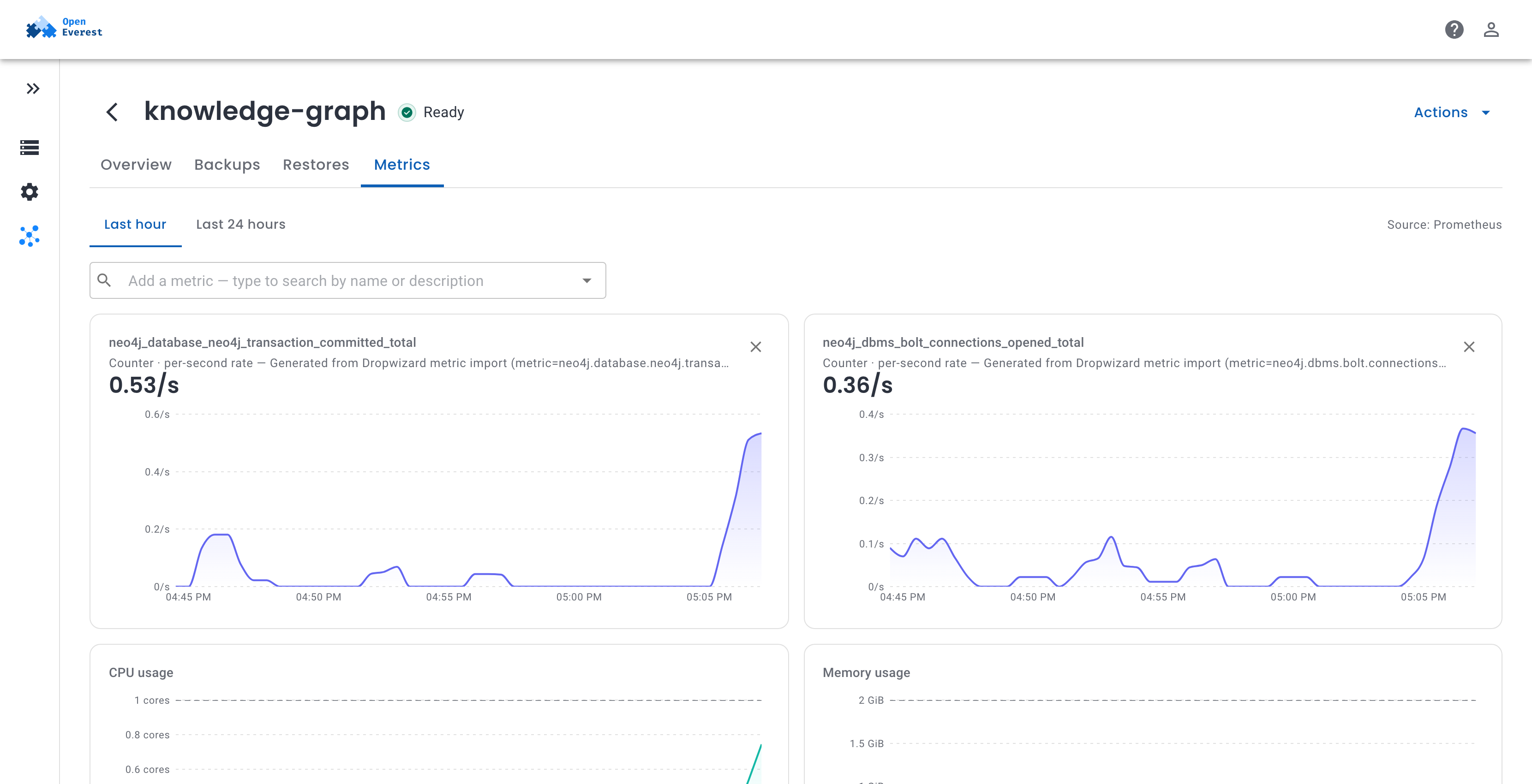
Neo4j Metrics
Chart any Neo4j metric, such as committed transactions or Bolt connections, next to the CPU and memory of every member on the instance page.
Key capabilities
Community or Enterprise
Run a single Community server by default, or switch to Enterprise for clusters, online backups, and metrics. You accept the Enterprise license yourself, for production or evaluation.
Clusters That Grow
Run primaries for writes and add analytics and read servers next to them. Change members, CPU, and memory, grow volumes, and upgrade Neo4j with a rolling restart.
TLS by Default
Bolt and HTTPS are encrypted from the first start, with a CA managed through cert-manager or your own Secret or Issuer, and the CA is published with the connection details.
Backups & Restores
Take online backups to S3-compatible storage on demand or on a schedule with retention, restore one in place, or start a new instance from it.
Prometheus Metrics
Send Neo4j Enterprise metrics to Prometheus or VictoriaMetrics with one choice, and chart them on the instance page.
Reach It Anywhere
Keep the database on a ClusterIP Service, or expose Bolt and HTTP(S) through a NodePort or LoadBalancer, on any cloud or on-premises.
Open-source repositories
Powered by
Neo4j is the graph database that stores data as nodes and relationships and queries it with Cypher. Neo4j Community Edition is open source under the GPLv3.
The Neo4j Kubernetes Operator runs Neo4j servers and clusters on Kubernetes, with TLS, backups, and restores.
Frequently asked questions
Is Neo4j free to run on OpenEverest?
How does OpenEverest run Neo4j under the hood?
Instance, Backup, and Restore resources into the Neo4j, Neo4jBackup, Neo4jBackupSchedule, and Neo4jRestore resources of the Neo4j Kubernetes Operator, which runs the servers. The provider reports health, connection details, and credentials back onto the Instance and never manages pods directly.Which Neo4j versions are supported?
What is the difference between primaries, analytics, and read servers?
Where are backups stored, and how do I restore one?
How do I connect to Neo4j?
neo4j+s:// connection URL, and OpenEverest stores them, with the TLS CA, in a Kubernetes Secret. Connect with any Neo4j driver, Cypher Shell, or Neo4j Browser over Bolt. Choose a NodePort or LoadBalancer Service to reach the database from outside the cluster.How do I monitor Neo4j?
Ready to get started?
Deploy OpenEverest on any Kubernetes cluster and run your first Neo4j graph database in minutes.
Neo4j, Cypher, and the Neo4j logo are trademarks of Neo4j, Inc. OpenEverest is not affiliated with, endorsed by, or sponsored by Neo4j, Inc. These names are used for identification purposes only.
