
OpenEverest for Milvus
Run Milvus, the open-source vector database, on any Kubernetes cluster. Deploy a single-process standalone instance or a distributed cluster, autoscale query nodes, roll out upgrades without downtime, and back up collections to S3 through a single UI and API, powered by the Milvus Operator.
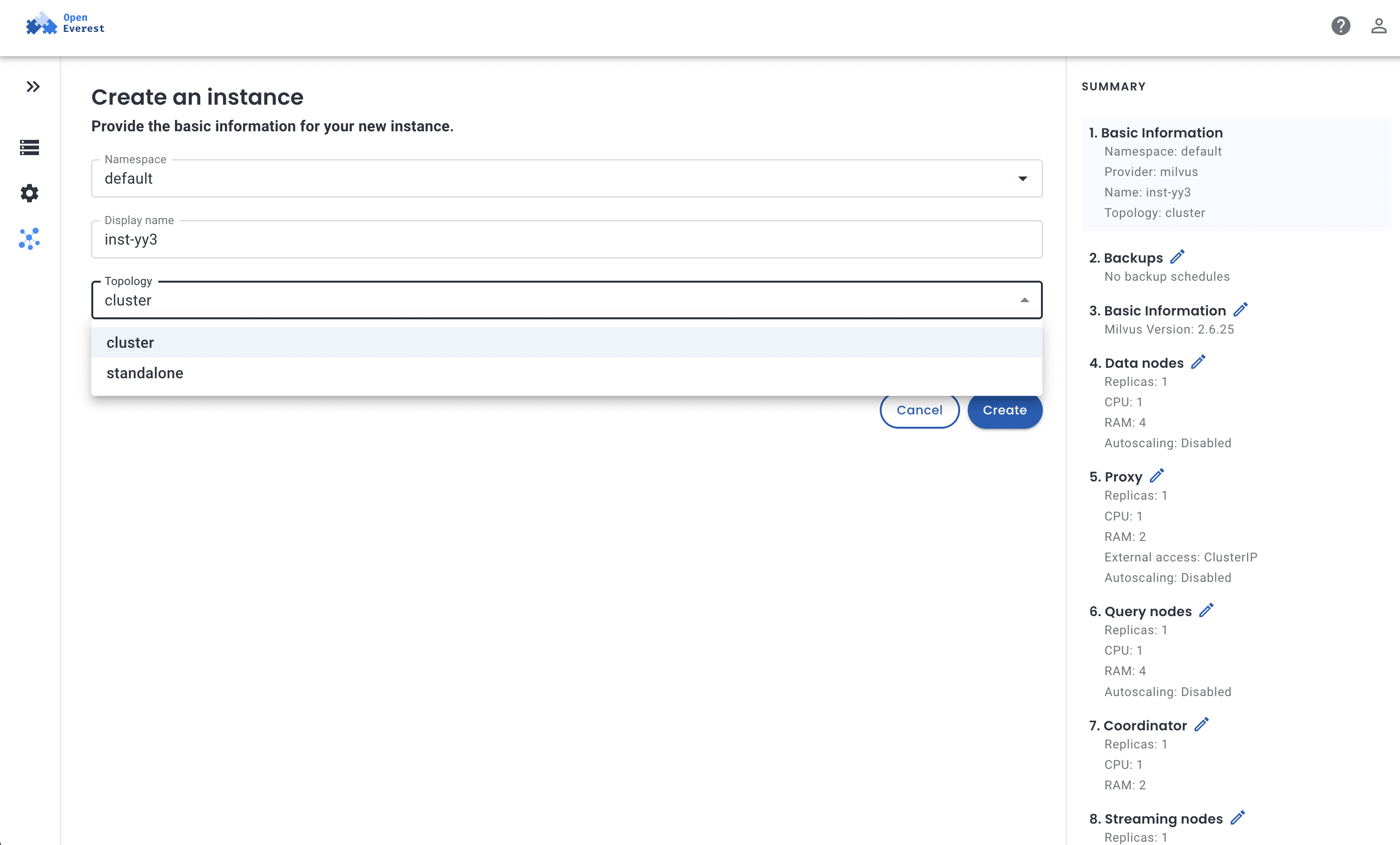
Standalone or Cluster
Pick a single-process standalone instance for development, or a distributed cluster with independently sized proxies, query, data, and streaming nodes - and review every setting before you create it.
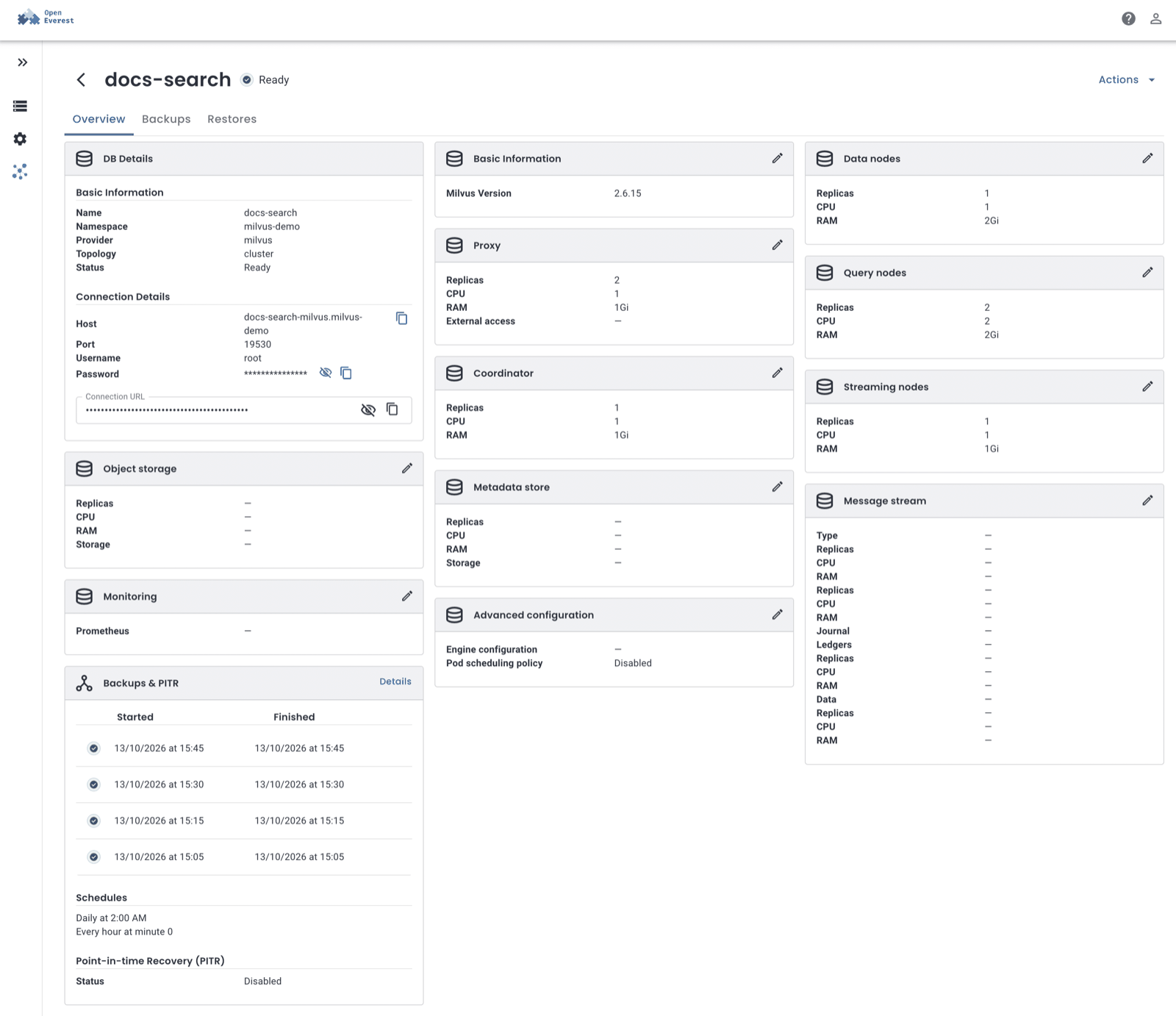
Instance Overview
See every component at a glance, copy the host, port, root credentials, or connection URL into pymilvus or any Milvus SDK, and edit sizing in place.
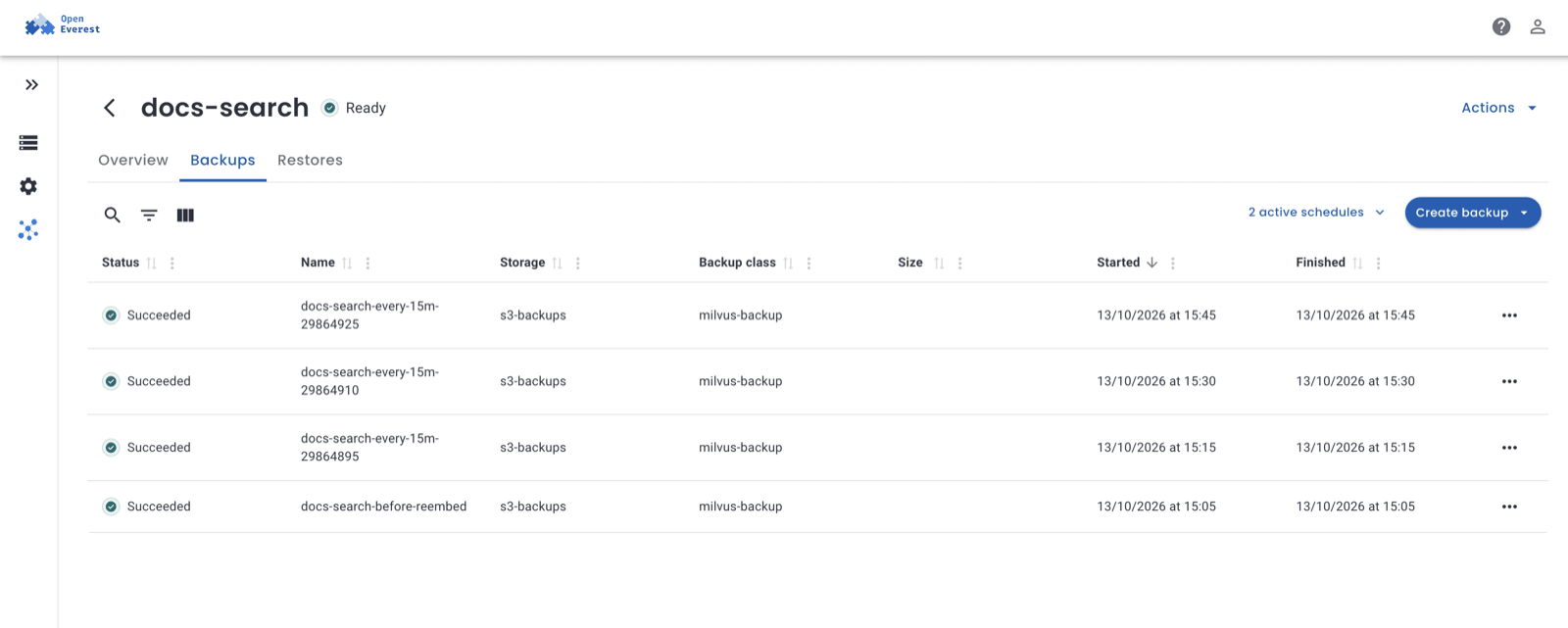
Scheduled Backups
Back up collections on demand or on a schedule to any S3-compatible storage, with retention, and restore them into the same instance or a new one.
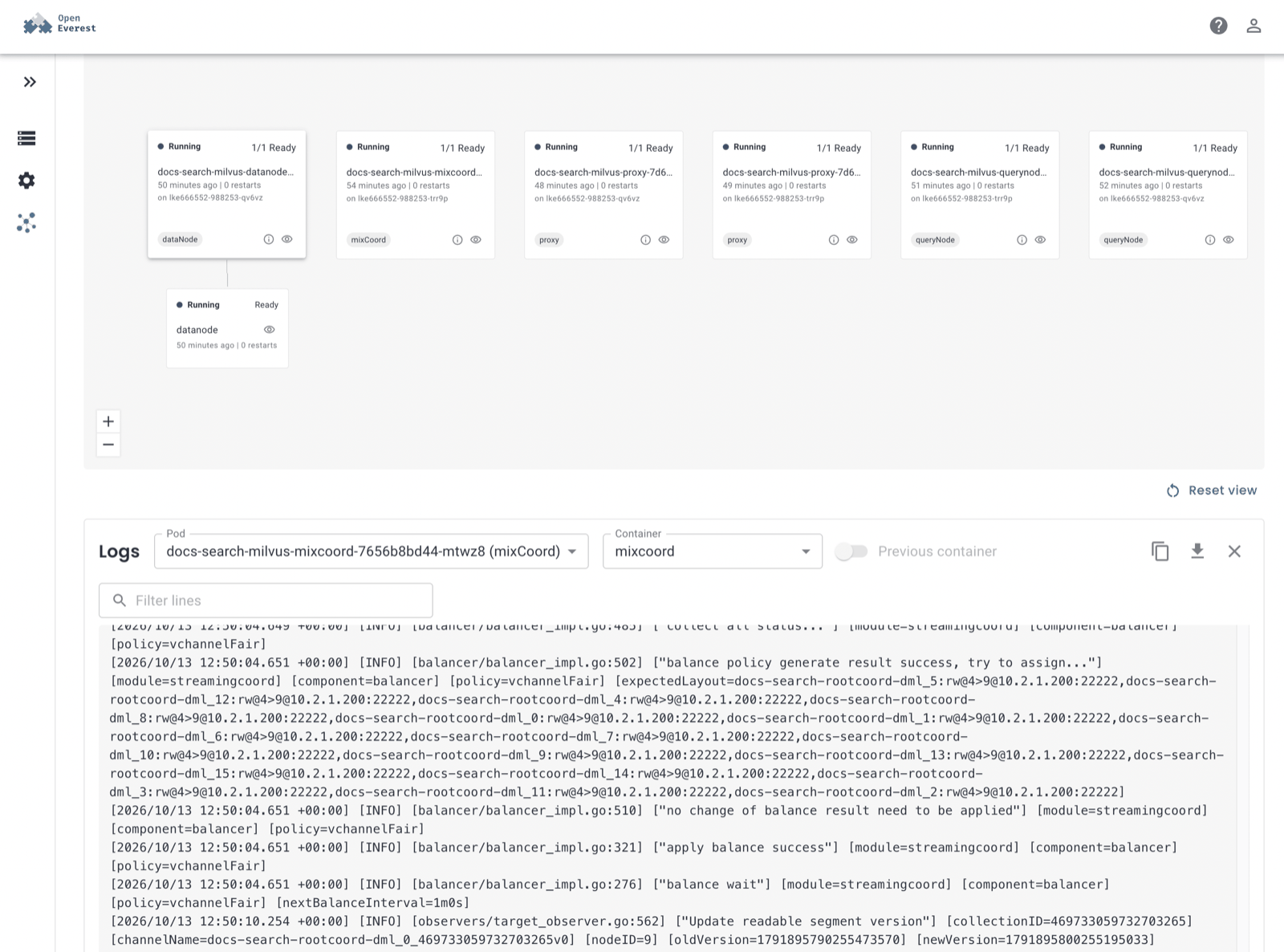
Visual Inspector
Follow every Milvus pod as a live graph - status, readiness, restarts, and node placement - and stream logs from the coordinator, proxies, or query nodes without leaving the UI.
Key capabilities
Standalone or Distributed
Start with a single-process instance, or run Milvus 2.6 as a cluster with an active-standby coordinator and separately scalable proxies, query, data, and streaming nodes.
Scaling & Autoscaling
Scale each component on its own and let proxies, data, and query nodes autoscale on CPU or memory. Scaling in below what a loaded collection's replicas need is refused.
Backups & Restore
On-demand and scheduled backups to S3-compatible storage with count- or time-based retention, restored into an existing instance or a brand-new one.
Rolling Upgrades
Curated Milvus 2.6 versions, upgraded component by component in the right order. Downgrades are refused, because Milvus migrates its metadata on upgrade.
Bundled or External Dependencies
Get etcd and object storage bundled and sized for you, with the write-ahead log kept in object storage (Woodpecker) - or point Milvus at your own etcd and S3-compatible bucket.
GPUs & Node Pools
Switch to GPU builds with one version change, and split query nodes across GPU pools - with their own node selectors, tolerations, and secondary networks.
Secure by Default
Authentication is always on: OpenEverest generates the root password and the storage credentials, keeps them in Kubernetes Secrets, and applies a new root password when you change it.
Open-source repositories
Powered by
Milvus is the open-source, cloud-native vector database built for scalable similarity search on billions of vectors.
Milvus instances on OpenEverest are powered by the open-source Milvus Operator, which manages Milvus and its dependencies on Kubernetes.
Backups and restores run the upstream milvus-backup tool, which copies collections and their index definitions to S3-compatible storage.
Ecosystem & extensions
Extend Milvus on OpenEverest with community plugins and integrations.
Inspector
An OpenEverest UI plugin that adds an Inspector tab to instance pages: the pods behind a Milvus instance as a live graph or a table, streamed container logs, and kubectl-style pod details.
openeverest/plugin-inspector →Prometheus
Turn on monitoring and OpenEverest creates a PodMonitor that scrapes every Milvus component, ready for your Prometheus and Grafana dashboards.
prometheus-operator/prometheus-operator →Frequently asked questions
Is Milvus free to run on OpenEverest?
What is a vector database used for?
How does OpenEverest run Milvus under the hood?
Instance into a Milvus resource for the open-source Milvus Operator, which runs Milvus and its etcd and object storage. Read the walkthrough in Milvus on OpenEverest.Standalone or cluster - which should I choose?
Which Milvus versions are supported?
Do I need Pulsar or Kafka?
Can I use my own S3 bucket and etcd?
rootPath lets several instances share one bucket or etcd.How do backups and restores work?
Can Milvus use GPUs on OpenEverest?
Ready to get started?
Deploy OpenEverest on any Kubernetes cluster and run your first Milvus vector database in minutes.
Milvus and Zilliz are trademarks of their respective owners. OpenEverest is not affiliated with, endorsed by, or sponsored by these organizations. These names are used for identification purposes only.
