OpenEverest for KServe
Run Model-as-a-Service on your own Kubernetes and GPUs. Deploy LLMs with vLLM in a few clicks and serve them behind one authenticated, OpenAI-compatible endpoint with per-model API keys, token quotas, and models that span several GPU nodes, powered by KServe.
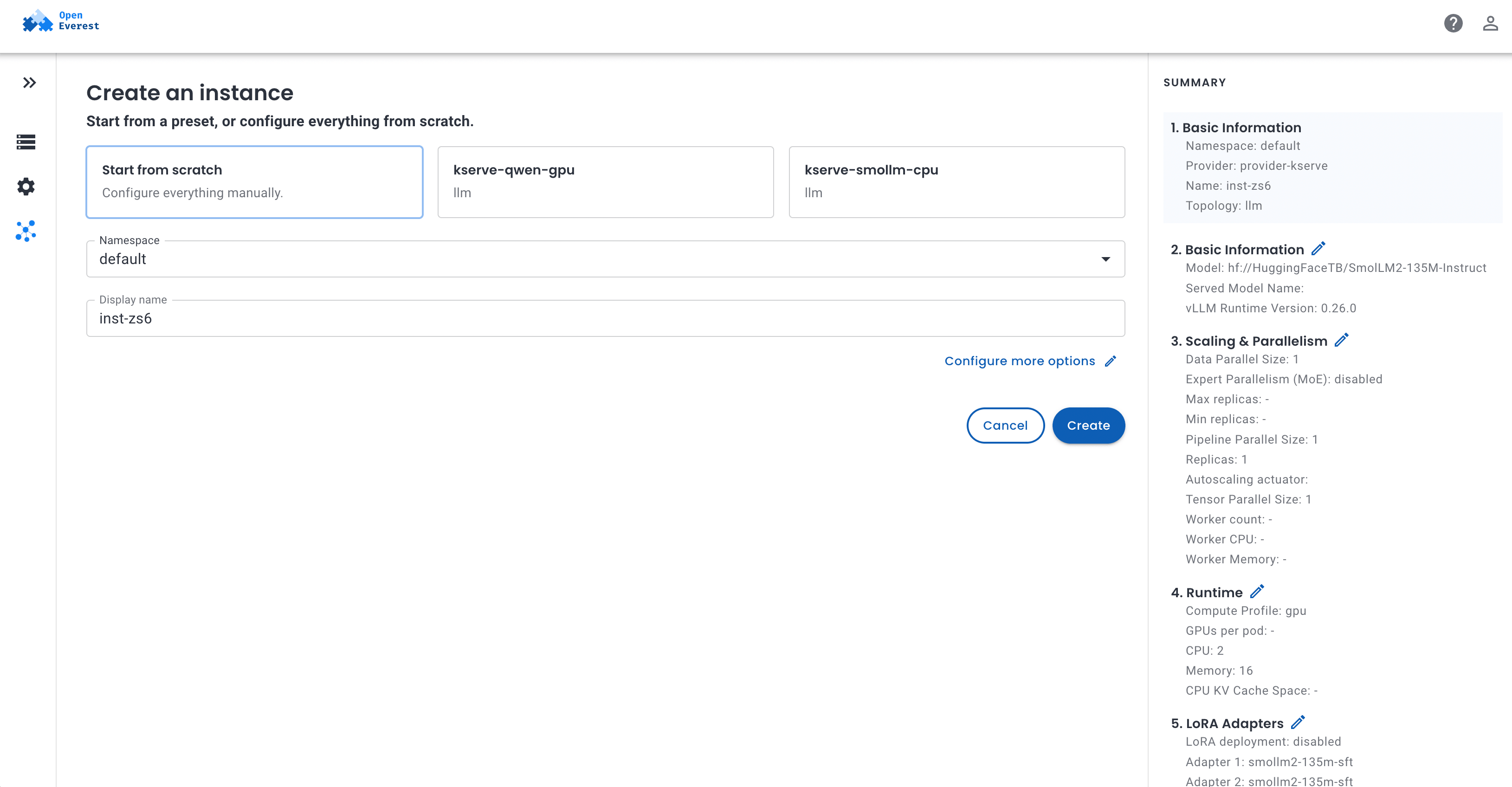
Start from a Preset
Deploy a model with one click from a ready-made preset - a small GPU model or a CPU-only one for smoke tests - or configure everything from scratch.
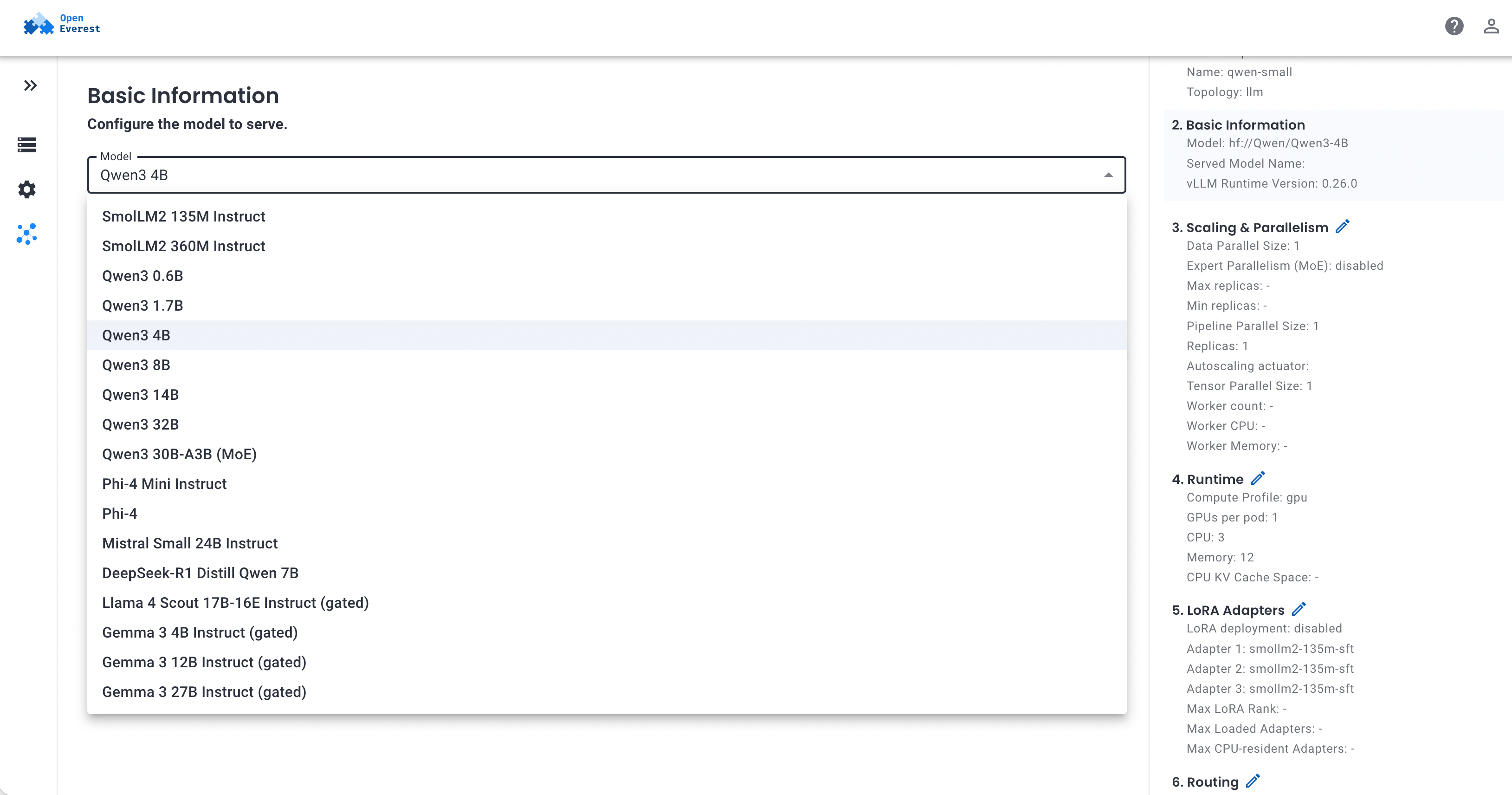
Pick a Model from the Catalog
Choose from a curated catalog - Qwen3, Phi-4, Mistral Small, DeepSeek-R1, Gemma 3, Llama 4 - or point to any Hugging Face, S3, GCS, or PVC model URI.
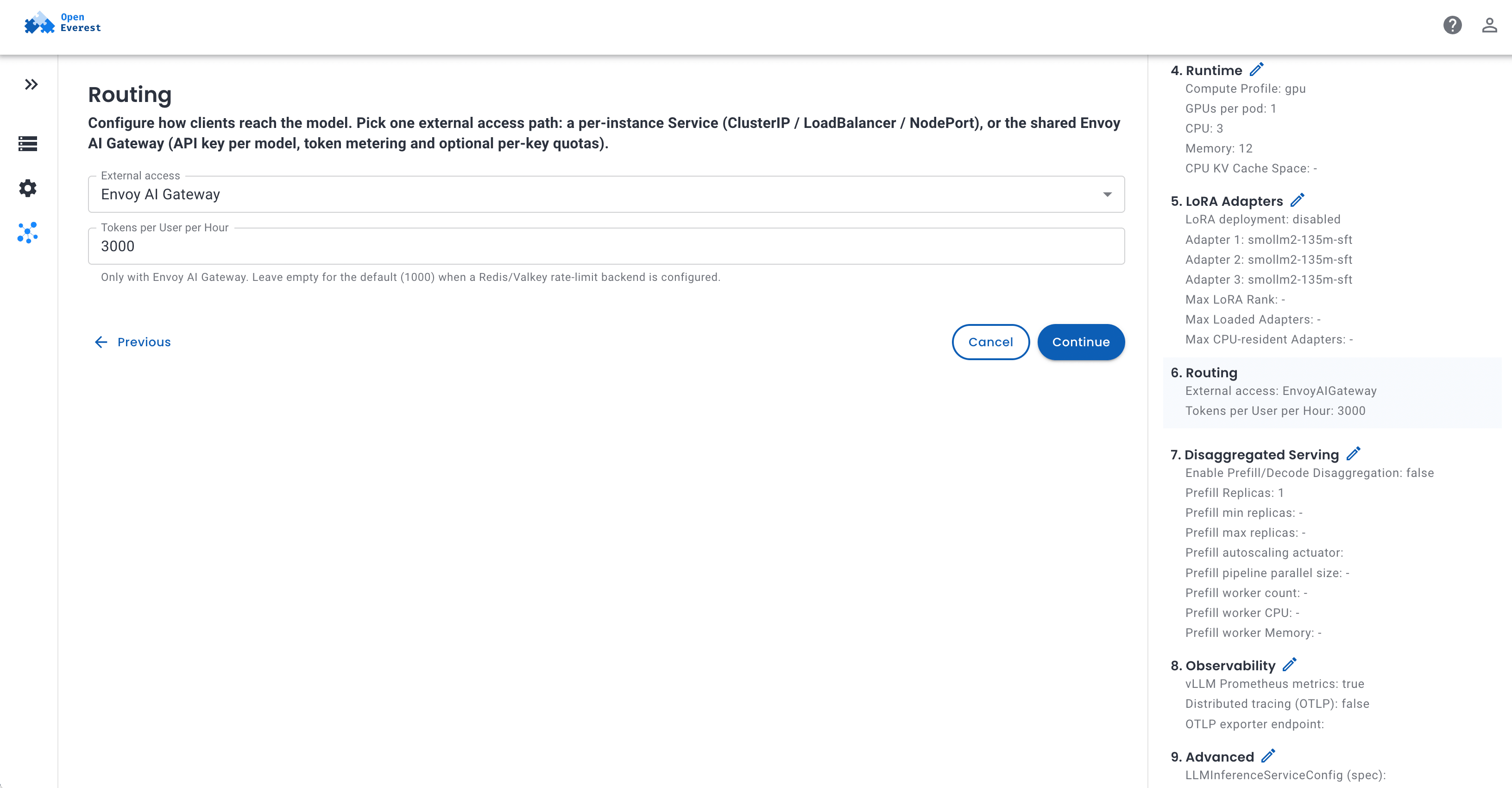
Expose Through the AI Gateway
Put the model behind the shared Envoy AI Gateway with its own API key, and optionally cap how many tokens each key can spend per hour.
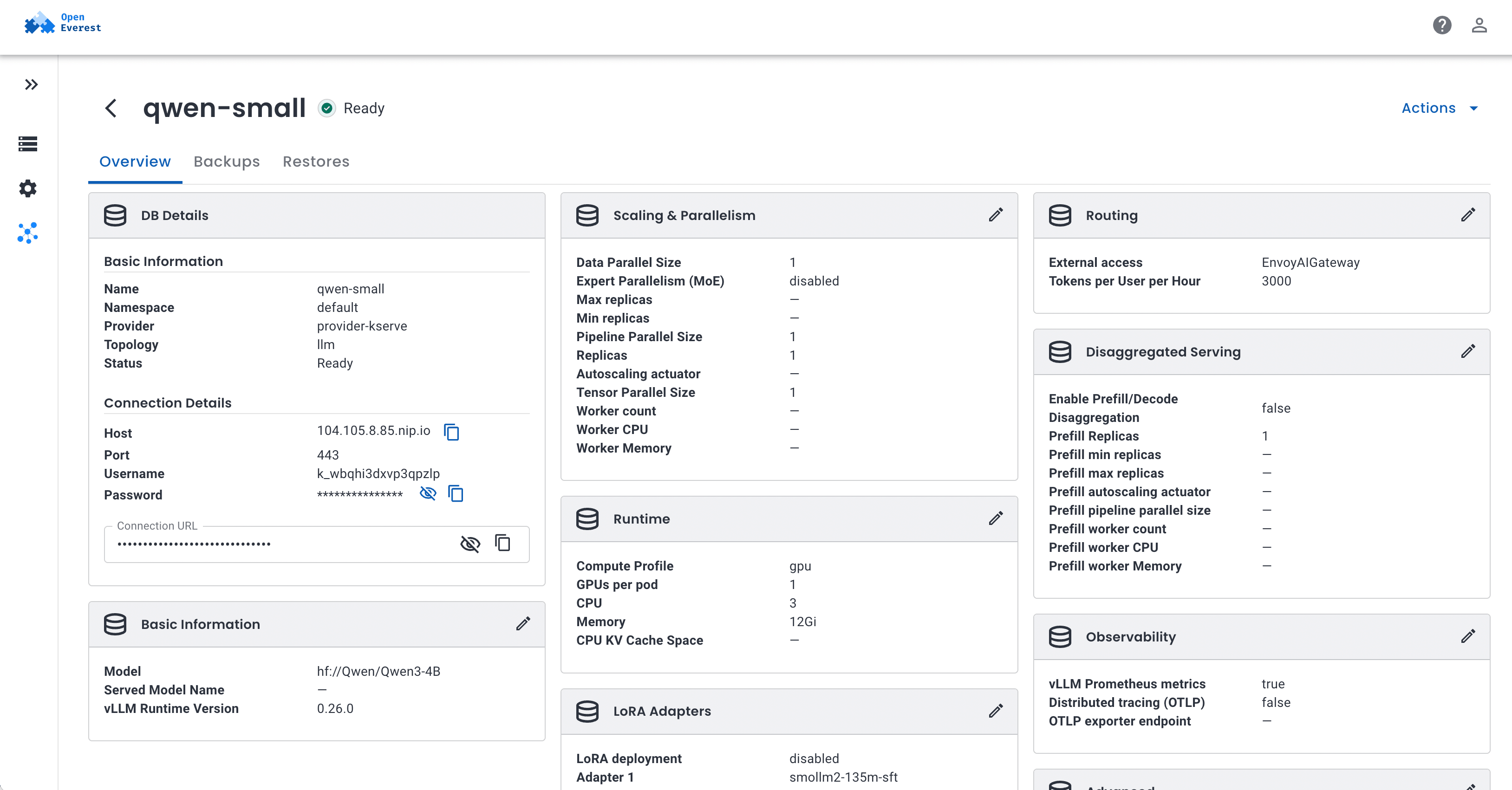
Ready to Call
Copy the HTTPS endpoint and API key straight into the OpenAI SDK or any OpenAI-compatible tool.
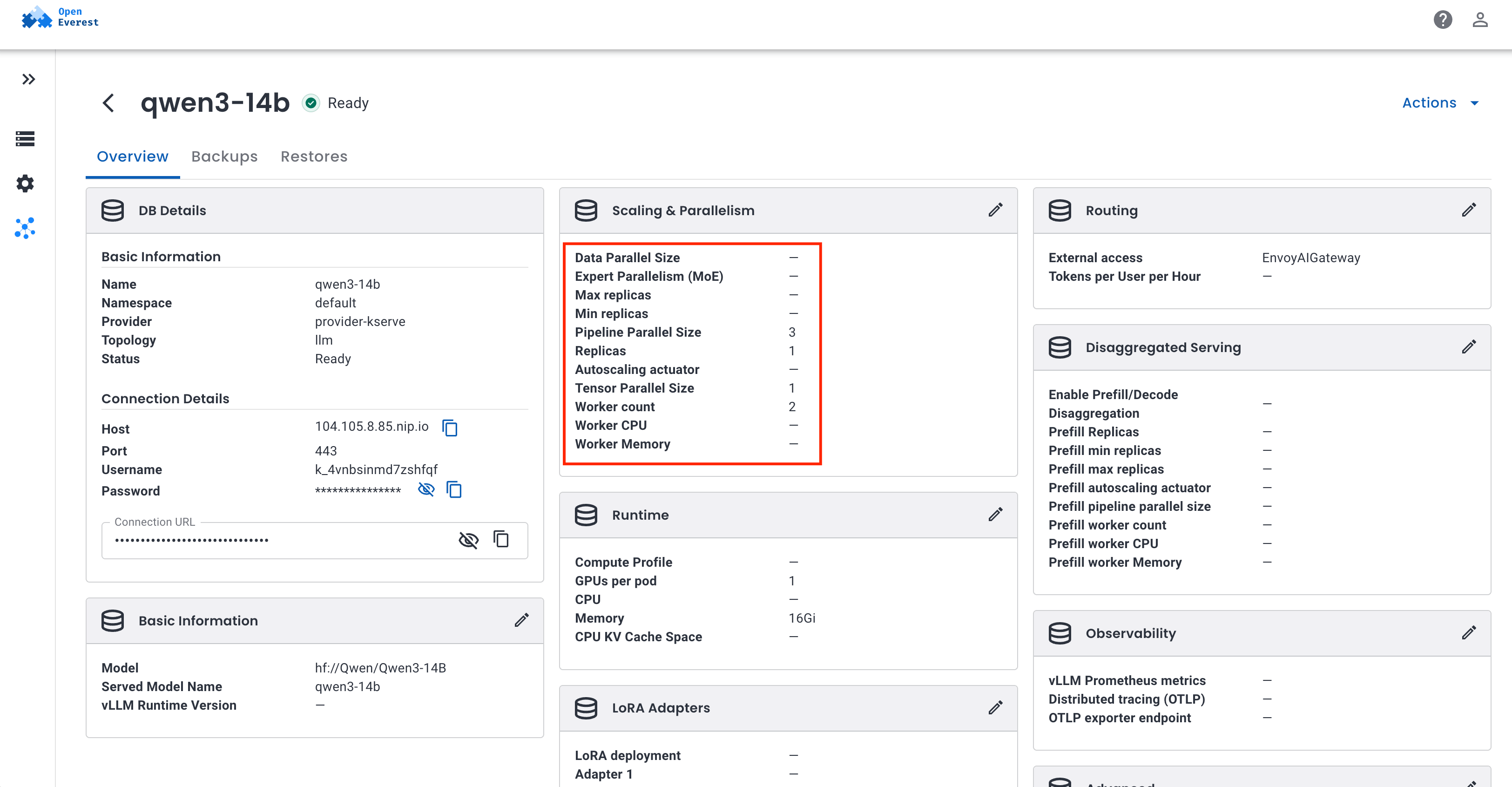
Models Bigger Than One Node
Split a model across GPU nodes with pipeline parallelism - here Qwen3 14B runs as a head and two workers on three 20 GB GPUs.
Key capabilities
Authenticated AI Gateway
One HTTPS endpoint for all models. Each model gets its own API key, checked at the edge - a key for one model cannot call another.
OpenAI-Compatible
vLLM serves the standard /v1 API, so the OpenAI SDK, LangChain, and other OpenAI-compatible tools work without code changes.
Multi-Node Models
Tensor parallelism across GPUs in a node and pipeline parallelism across nodes, so models bigger than one server still run as one endpoint.
Token Quotas
Meter real prompt and completion tokens per API key, and enforce hourly budgets per model with a Redis or Valkey backend.
Presets & Model Catalog
Platform teams curate the models and ship known-good presets; users deploy with one click or a short Instance manifest.
Observability
vLLM metrics through a managed PodMonitor, per-key token usage from the Gateway, and optional OpenTelemetry tracing.
Your GPUs, Anywhere
Run on EKS, GKE, AKS, GPU clouds, or bare-metal clusters - your models, prompts, and data never leave your infrastructure.
Open-source repositories
Powered by
Models on OpenEverest are served by KServe, the open-source, Kubernetes-native platform for generative and predictive AI inference.
vLLM is the high-throughput inference engine that runs the LLMs, with tensor and pipeline parallelism across GPUs and nodes.
Envoy AI Gateway routes requests by model name, checks API keys, and meters tokens at the edge.
Frequently asked questions
Is KServe free to run on OpenEverest?
What is Model-as-a-Service?
Is the API compatible with OpenAI?
base_url at the endpoint from the connection details and use the API key as the key. Anthropic-style clients can send the key in the x-api-key header.Which models can I serve?
hf://), S3 (s3://), Google Cloud Storage (gs://), or a PersistentVolumeClaim (pvc://). The UI offers a curated catalog, and gated models work once you provide a Hugging Face token. Predictive models (scikit-learn, XGBoost, PyTorch, TensorFlow, ONNX, Triton) are supported too.How are models secured?
401, and a key for a different model gets 403. Rotating a key takes seconds.Can I serve a model that does not fit on one GPU or one node?
Do I need GPUs?
Ready to get started?
Deploy OpenEverest on any Kubernetes cluster and serve your first model behind an authenticated, OpenAI-compatible API in minutes.
KServe, vLLM, and Envoy are trademarks of their respective owners. Model names are trademarks of their respective owners and are used for identification purposes only. OpenEverest is not affiliated with, endorsed by, or sponsored by these organizations.
