
provider-cloudnative-pg is now an official OpenEverest provider
 Sergey Pronin
The community-built CloudNativePG provider — started as a personal project by Aditya Pimpalkar in June — has moved into the OpenEverest organization.
The first open-source platform for automated database, storage and LLM provisioning and management. It supports multiple database technologies and can be hosted on any Kubernetes infrastructure, in the cloud or on-premises.
Managed database services tie your data to one cloud and one vendor's roadmap. OpenEverest gives your teams the same self-service experience on infrastructure you control.
100% open source under Apache 2.0 and a CNCF Sandbox project. Your data, clusters, and tooling stay portable.
Skip months of building an internal DBaaS. Provisioning, scaling, backups, and monitoring work out of the box.
Run on any Kubernetes — public cloud, private cloud, or bare metal — and keep data where cost, latency, and compliance require.
Every technology is a provider. Add databases, caches, or AI runtimes from the hub, or build your own with the Provider SDK.

Synchronous replication with Percona XtraDB Cluster.

Highly available MariaDB with point-in-time recovery.

Replica sets and sharded clusters, backed up.

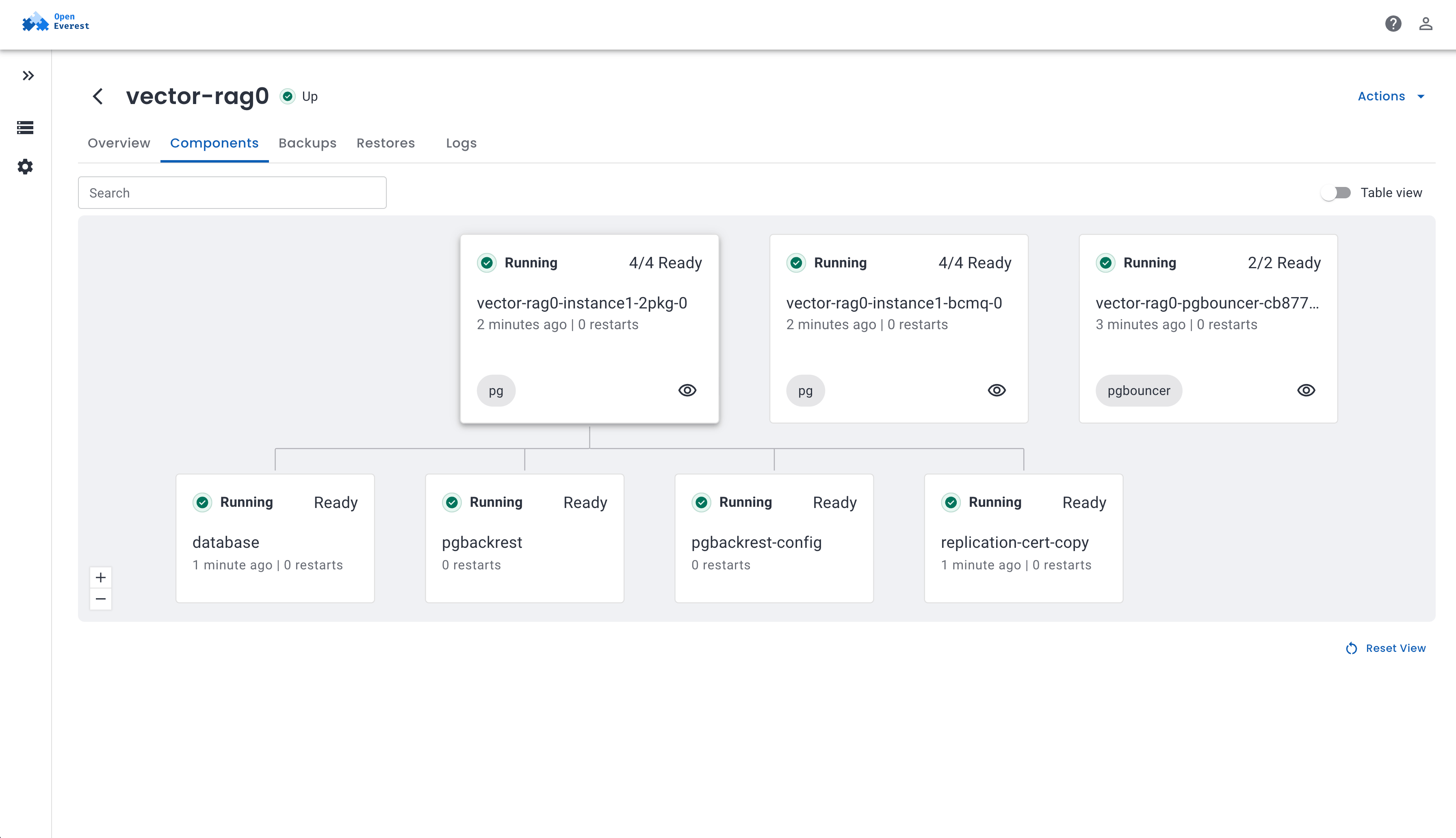
Highly available Postgres with CloudNativePG or Percona.

Real-time analytics on replicated clusters.

Always-On Availability Groups on Kubernetes.

Distributed, MySQL-compatible SQL with built-in HTAP.

Redis-compatible caching and key-value at scale.
From the first click to the thousandth backup, OpenEverest automates the database lifecycle so your team doesn't have to.
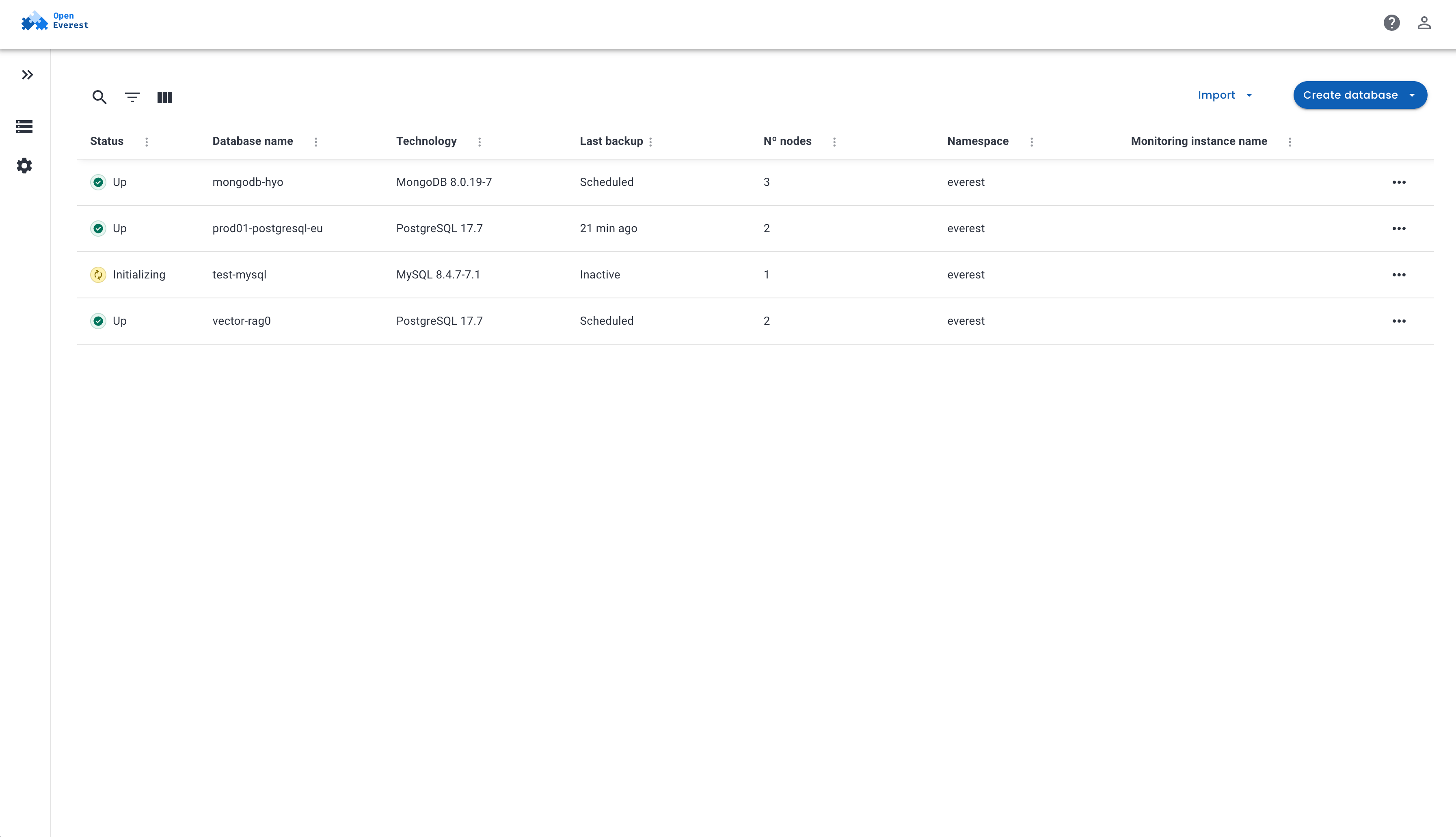
Create production-ready databases from the UI, API, or CLI in minutes, with topologies, versions, and presets built in.
Add nodes, shards, or replicas, adjust CPU and memory, and grow storage as your workloads change.
Schedule backups to S3-compatible storage, recover to a point in time, or clone a new instance from any backup.
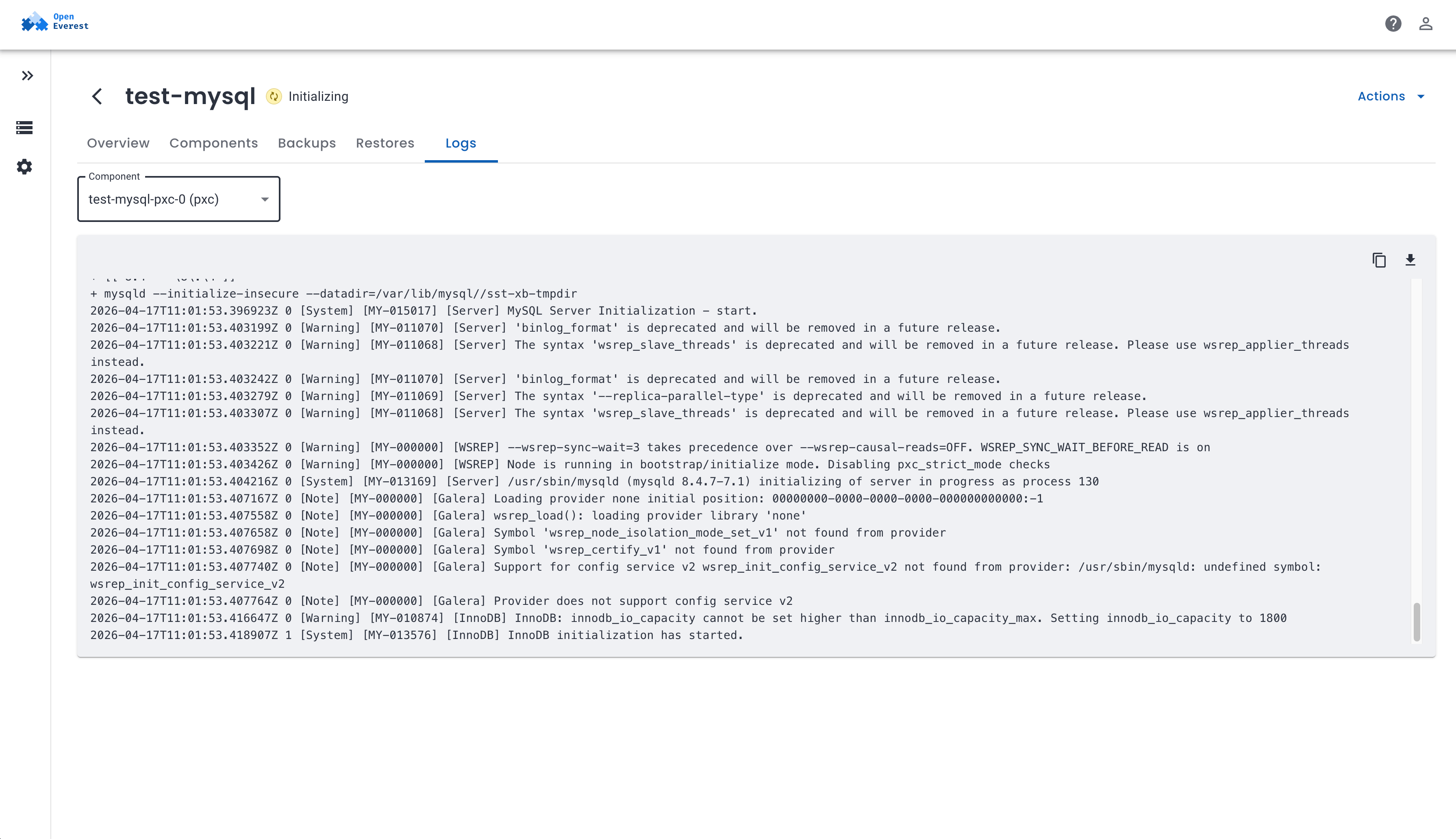
Plug metrics into the observability stack you already run. No mandatory monitoring tool, no extra agents to babysit.
TLS, generated credentials, and role-based access control keep every instance locked down from day one.
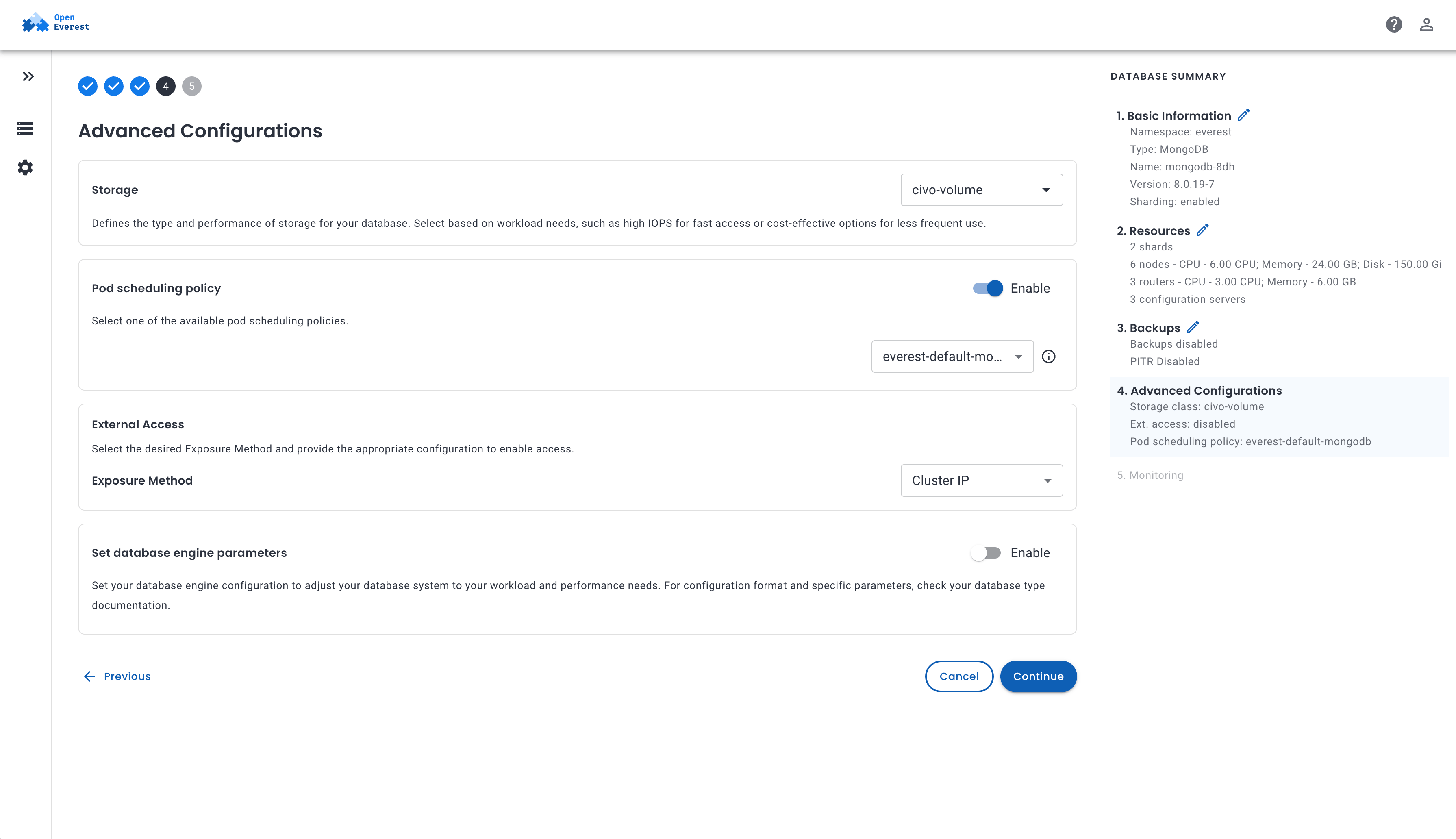
Tune engine parameters, storage classes, scheduling, and external access without ever touching kubectl.
OpenEverest thrives because of its open, collaborative community. Whether you're a developer, operator, or enthusiast — there are many ways to get involved.
OpenEverest is open source and thrives on community contributions. No contribution is too small — whether it's code, documentation, or website improvements.
All projects are Apache 2.0 licensed. We welcome PRs and issues!
New to contributing? Start here! Browse beginner-friendly issues across all OpenEverest repositories.
OpenEverest participates in the Linux Foundation's LFX Mentorship program. Work on real OpenEverest features with experienced maintainers as your guides.
Join our real-time discussions on CNCF Slack. New to CNCF Slack? Grab a workspace invite first, then join our channel.
Found a bug or have an idea? Open an issue or start a discussion.
Join us every two weeks for live updates, demos, and open Q&A with the OpenEverest team and contributors.
Discover where we're heading and help shape the future of database operations on Kubernetes.
OpenEverest aims to become the standard for database operations on Kubernetes, empowering teams to deploy, manage, and scale databases with confidence.
Explore Our VisionSee what we're building next and track our progress. Our roadmap is public and community-driven.
View RoadmapWant to influence where the project is going?
Propose a FeatureThe community-built CloudNativePG provider — started as a personal project by Aditya Pimpalkar in June — has moved into the OpenEverest organization.

The banner at the top of openeverest.io keeps inviting you to talk to a maintainer. This post explains who those calls are for, what happens on them, and how to book one.

We ran TiDB on an 8-node Kubernetes cluster with OpenEverest and TiDB Operator v2 and measured everything a self-hoster asks about: time to a working cluster, HTAP with TiFlash under CH-benCHmark, scaling under load, backups to S3, restores, upgrades and TLS.

Models served by OpenEverest no longer have to share one API key. With the User Management plugin, every application, team or person gets its own key for a model, with its own token quota, its own usage metrics, and rotation or revocation that affects nobody else.

OpenJev is an open-weights decision model: you ask a typed question, it answers with a probability for every option in one forward pass. I ran it on a $0.67/hour GPU with OpenEverest and KServe, let it triage 299 real KServe issues and diagnose 19 broken pods, and published it on the Envoy AI Gateway with API keys and token quotas. Here is what it got right, what it got confidently wrong, and the prompt fix that made things worse.
Meet Shivansh Sinha — a DevOps and backend engineer in Bengaluru who started by filing bugs against the OpenEverest v2 dev builds, and kept going until he was fixing them himself.
Find answers to common questions about OpenEverest
kubectl. Or you let OpenEverest do it.OpenEverest is 100% open source and community-driven. All components are available under the Apache 2 license on GitHub.
Originally created by

CNCF Sandbox Project

